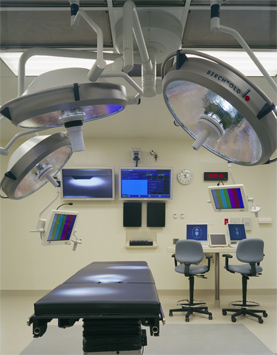
 Two weeks ago today, I was told that I needed surgery in order to correct my paraumbilical hernia. (Although most male hernias are corrected through an incision in the groin, mine was going to require a cut right above the belly button, through the abdominal muscles.) Knowing that this was my only option, I decided that instead of having thoughts of this upcoming surgery lingering in my head for days or weeks on end, that I would prefer to get it done, and over with, as quickly as possible.
Which–don’t get me wrong–doesn’t mean that I wasn’t preparing myself as much as possible for the surgery. In fact, quite the opposite took place…but as a 39 year-old-guy who had never undergone a surgical procedure in his life, and despite all of the information that is available online, I still really didn’t know exactly what to expect.
Since I live with rheumatoid arthritis, I know that I will one day reach a point where surgical procedures become a more common part of my life, whether it be arthroscopic joint cleaning or partial/complete joint replacements. So while my surgery a few days ago had nothing to do with my RA, I decided to adopt the mentality that I was going to try to learn as much as possible from this procedure and hospital stay, so that I may be better prepared when I have to undergo some of the inevitable RA-related surgeries down the road.
What have I learned so far?
Find information online (wisely). The Internet has become one of our first go-to’s, when it comes to finding information…as is no doubt should be. I think it’s important, however, to use this information wisely. Case in point: in the days leading up to my surgery, Googling “hernia surgery” would return lots of helpful information, including (whether “helpful” or not, I sure both sides could be argued!) pages with titles along the lines of “Percentage of deaths associated with hernia repair surgery.” Now I’ve never been a bury-your-head-in-the-sand type of person, but I found nothing beneficial with this type of information in the days before my surgery, and accordingly did not click on any such link.
I should also share an example on how the information I found online actually made me underestimate how difficult and painful my recovery was actually going to be–the constant repetition of two words: outpatient surgery. My surgeon from the get-go informed me that he planned to keep me in the hospital at least three nights. As I continued to read US-based content which continued to shine a positive light on the fact that you will more than likely get to go home the same day of surgery (yippee!), I started to think that my doctor here in South America was just being overcautious. I have since learned that I needed *every* minute that I spent in the hospital, and during the first day of my recovery I wondered how they could possibly even think of sending someone in my condition home. (I was once again sadly reminded how so many medical decisions in my home country are based on financial interests, and not patient concerns.)
Start a true countdown, one day in advance. Exactly 24 hours before I was going to be admitted into the hospital, I started my mental countdown. Luckily I had nothing scheduled for that day, so I could focus all of my time and energy on getting ready. I signed offline, packed my bag for my hospital stay, read, watched some mindless television shows, took a nap, and so on. Some people may think that I was trying to keep my mind off the events of the following day…but surprisingly enough, I did the exact opposite. I started to envision what is was going to be like walking into the hospital, being wheeled into the surgery room, waking up from my surgery, what the first 24 hours might be like, what the first 48 hours might be like, etc. I did so in a way, however, that didn’t make me nervous, but that made me feel prepared…and I continued to repeat this affirmation: I am having surgery to improve my health. I may experience some pretty intense pain, but my healing has *already* started.
In the hours leading up to surgery, relax as much as possible. By this point, everything is already in motion. I have been admitted in the hospital, and my abdomen has already been shaved. Now it’s time to play some Sudoku, listen to some music, chat with people around me, and so on. Instead of thinking of the arrival of the bed which will take me to the surgery room as the scary first step of the surgery process, I remind myself that I am already in the midst of the process, and that being wheeled to the surgery room will just be the next step of many which has already started. As a big fan of Bach Rescue Remedy, I also use these few hours before surgery as an opportunity to enjoy some Rescue Pastilles, Rescue Gum, and Rescue Remedy Spray.
Never underestimate the importance of reminding hospital staff that you have RA. Sure, it’s written down somewhere in my charts…but the person who is wheeling me to the surgery room, or–in my case–the person who is prepping me on the surgery room table, probably is not aware of the fact that I live with rheumatoid arthritis, and that extra caution should be used when moving my limbs or joints. (One of my last coherent memories was the flash of pain that passed through my right shoulder, as my right arm was being strapped into its holder…and even though I was already starting to fade, I made a point of telling everyone in the operating room that I had rheumatoid arthritis, and that extra care needed to be used when moving my body.)
On a funny side note, I am 5′ 11-3/4″ tall. (Or basically six feet, for practical purposes…or 1.83m, for metric folks.) Being a resident of an Andean country in the heart of South America has always presented certain challenges when it comes to finding clothes and shoes, due to the fact that I am so much taller than the average person. (Local average male height: 5′ 3″.) Well, as soon as I lay down on the operating table, I immediately thought to myself: here we go again! Both of my feet, all the way up to the shins, were dangling over the bottom edge of the table. Luckily I was not the first person who encountered this situation, immediately an table extension was ordered, and wheeled into place.
There might be moments when I feel completely unprepared, but I have to trust that everything is okay. For me, these were the two hours that I spent in post-operative recovery. While deep down I knew that this was the best thing for me, I just wanted to go back to my room and be surrounded by people I knew (and continued to say as much to anyone who approached my vicinity.) As the anesthesia started to wear off, and as I started to experience a pain in my abdomen unlike anything I had ever experience before, I slightly chuckled to myself that being wheeled into the operating room was the easy part…and it wasn’t until I was wheeled out, that the true nature of my challenge really became evident. I was tired. I was woozy. I was in pain. I was thirsty. I was getting annoyed that some buzzer next to me kept on going off. I was getting more annoyed when the nurses repeatedly told me that I needed to take deep breaths. I kept on taking off my oxygen mask. They kept on putting it back on. (Did I mention we’re at 12,000 feet above sea level?) I was, to put it quite frankly, just another extremely cranky patient recovering from surgery…but in the midst of my drug-induced stupor, I continued to smile, and told myself that I had every right to be cranky!
In the hours and days following, take things S-L-O-W-L-Y! One thing that only those of us who live with rheumatoid arthritis will ever experience: the hilarity of reminding yourself that you need to be as patient as possible with, and work as much as possible on, your recovery…so that you can as quickly as possible be back to the point where the *only* thing you have to worry about is, well, your chronic pain and disabilities. Or the confusion of trying to figure out if the difficulty walking is more related to your chronic condition, or to the huge incision in your stomach. Of having proudly declared in the days leading up to the surgery, that if you can deal with RA flares, then you can deal with anything! And then learning, soon enough, what’s it’s like to actually experience an RA flare less than 48 hours after surgery.
Following the dietary guidelines in the hospital is important; having a few small chocolates stashed away in the top drawer of your nightstand is even more important. (Enough said!)
And last, but not least.
Don’t forget to laugh…even when laughing hurts like heck, due to the big incision in your abdomen!
Stay tuned…for the next adventure of Rheumatoid Arthritis Guy!

 These are the top five posts on RheumatoidArthritisGuy.com, according to number of page hits.
 Over the past week and a half (don’t forget, I’ve only been home two weeks since spending three months in the U.S.), I’ve received more than my fair share of unsettling news. (Or, as I like to put it, I became a triple crown winner in the trifecta of chronic illness!)
 I’ve always been fascinated by images of people racing sailboats. The normally serene large and graceful upright sails that we associate with these boats gliding across the surfaces of calm lakes now appear to be tipping at very precarious angles, just seconds away from falling into the turbulent ocean water. You then zoom in on the picture, and become aware of the most intriguing part of all: the people who are practically hanging outside of the boat, balancing the entire thing while preventing the collapse of this delicate house of cards.
  Last night as I was falling to sleep, I decided to listen to Jon Kabat-Zinn’s